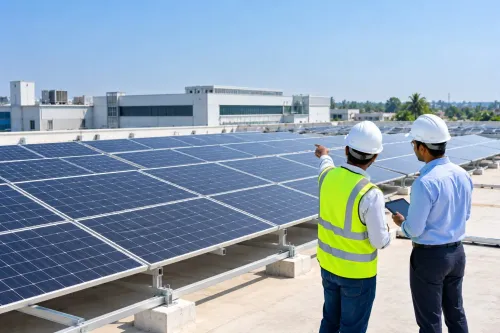

A commercial solar project can fail before installation if the roof, load profile, tariff, or utility approval is assessed incorrectly. By the end, you will be able to screen the building, size the system against actual usage, compare alternatives, and demand a proposal that accounts for interconnection, safety, performance, and long-term costs.
Key takeaways
- Measure usable roof area after access paths, drainage zones, and equipment clearances.
- Size the system from interval load data, not roof area alone.
- Compare solar with efficiency upgrades, tariffs, and other energy-cost measures.
- Require written guarantees for generation, approvals, commissioning, warranties, and maintenance.
Is the building ready for a solar array?
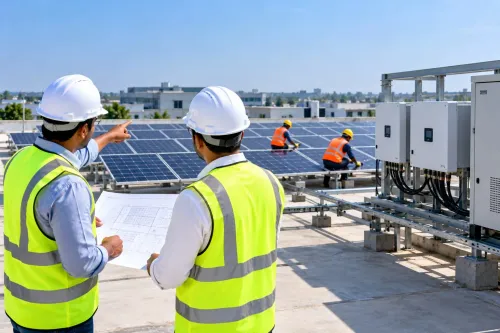
Do not request quotations from total roof square footage. Start with a measured roof plan and calculate usable roof area after removing fire-access pathways, maintenance paths, drainage zones, parapets, equipment clearances, roof setbacks, and other required setbacks.
Record roof orientation, obstructions, shade at morning, midday, and afternoon, plus nearby construction that could create future shade. Ask for an array layout that preserves access paths and equipment clearances.
| Quote basis | What it shows | Risk |
|---|---|---|
| Total roof area | The building footprint | Overstates installable capacity |
| Usable roof area | Space remaining after access, drainage, setbacks, and clearances | Supports realistic panel counts |
| Detailed layout | Panel positions, pathways, inverters, and maintenance access | Exposes conflicts before contracting |
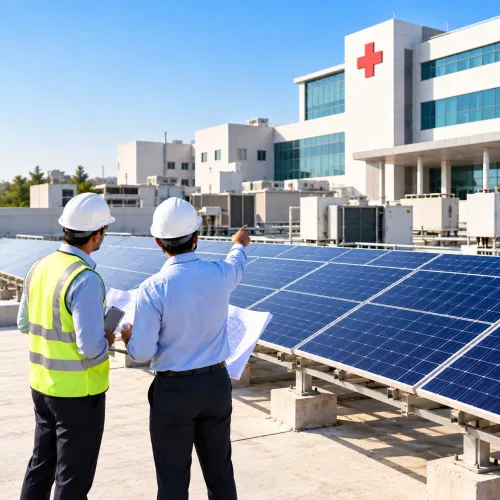
Obtain a structural review of rooftop solar before choosing equipment. The engineer must verify structural load capacity for module and racking weight, wind uplift, ballast movement, seismic forces, and snow where applicable, under the adopted building code.
The review must also cover attachment points, roof spans, and concentrated loads; a roof that carries evenly distributed weight can still fail beneath ballast or equipment.
Inspect the membrane, drainage, waterproofing, penetrations, and roof warranty. Compare remaining roof life with the PV operating period. Installing panels before reroofing can add removal, storage, reinstallation, and lost-generation costs, while unapproved penetrations can void warranty protection.
How large should the system be for the building’s actual usage?
Size the array against the hours and tariff value that let you use generation, not against empty roof area. Collect at least 12 months of electricity bills and, where available, 15-minute or 30-minute interval data.
Build the commercial load profile from:
- Operating hours, weekday and weekend occupancy, holidays, and seasonal demand.
- Daytime consumption, evening demand, peak demand, and sanctioned load.
- Monthly kWh, maximum kW, and periods when the building is closed or lightly occupied.
Annual matching is not enough. An array producing the building’s annual kWh can still export surplus midday power while evening purchases remain unchanged.
Read every bill by separating energy charges, demand charges, fixed charges, time-of-day charges, taxes, wheeling or grid fees, and minimum-billing provisions. Mark which charges solar can reduce and which remain after installation; solar that lowers kWh does not automatically remove demand or fixed charges.
Model monthly PV output after temperature, inverter, wiring, mismatch, shading, soiling, availability, and degradation losses. Require the forecast to state whether it represents a typical-year estimate or a guaranteed minimum.
| Option | Best fit | Test before choosing |
|---|---|---|
| Full-roof array | Strong daytime demand and valuable onsite use | Midday exports, export cap, and low weekend load |
| Smaller self-consumption array | Limited daytime demand or low export value | Lost generation savings versus avoided purchases |
Test export limits with the utility before selecting capacity. A smaller system can produce better bill savings than a full roof when surplus generation receives little compensation.
Does rooftop solar beat the other ways to reduce energy cost?
Compare every option over the same period, using the same tariff, load forecast, inflation, discount rate, tax treatment, and financing assumptions. A simple payback calculation can make an expensive solution look cheap.
| Option | Main value | Test against |
|---|---|---|
| Rooftop solar | Reduces purchased daytime energy | Export price, demand charges, roof and interconnection costs |
| Energy-efficiency upgrades | Cuts consumption before generation | Measured savings and equipment life |
| Open-access power | Buys power from an off-site project | Wheeling, banking, transmission, and contract charges |
| Third-party power purchase agreement | Buys solar energy without owning the system | Escalator, contract term, minimum purchase, and exit fees |
| Diesel generation | Supplies power during outages | Fuel, maintenance, runtime, emissions, and outage frequency |
| Battery storage | Shifts energy, limits exports, or supports critical loads | Battery storage economics and tariff value |
| Smaller array | Raises self-consumption and reduces capital | Lost generation versus avoided grid purchases |
Put these costs into every cash-flow model:
- Engineering, permits, interconnection studies and upgrades, structural repairs, metering, taxes, insurance, and financing.
- Cleaning, inspections, controls, roof work, inverter replacement, and eventual removal or recycling.
Solar can reduce energy charges without eliminating the bill. Fixed charges, demand charges, taxes, grid fees, minimum bills, and export limits can remain.
Test batteries against interval load data and the tariff. Model usable kWh, power rating, cycling limits, controls, fire-safety work, replacement, and round-trip losses; do not add storage automatically.
Model module degradation separately from inverter service life. NREL’s median reference of about 0.5% annual degradation informs the model, not a project guarantee.
What utility approval and backup arrangement will the project need?
Do not approve the array until the distribution utility confirms that the connection can accept it. Verify the current Maharashtra electricity rules and the commercial process of the actual utility, such as MSEDCL; residential net-metering assumptions do not transfer automatically to a commercial connection.
Ask the utility to confirm:
- sanctioned-capacity limit and permitted export limit
- application documents and technical-screening requirements
- transformer or feeder studies, protection changes, export controls, and service upgrades
- inspection sequence, approval timeline, and permission-to-operate conditions
- bidirectional meter replacement process and settlement period
- treatment of generation above the permitted export
Model the available billing arrangements before selecting equipment.
| Option | Settlement basis | What to model |
|---|---|---|
| Maharashtra commercial net metering | Export offsets imported energy under the approved rules | Export cap, settlement period, demand charges, fixed charges, taxes, and surplus treatment |
| Gross metering | All generation is exported and compensated under the approved rate | Export tariff, contract term, metering configuration, and loss of on-site offset value |
A retail tariff alone cannot establish savings.
Define backup separately. List critical loads, generator usage, required battery autonomy, available battery space, and the hours of backup required. A standard grid-connected system shuts down during an outage; it does not keep equipment running.
Hybrid or off-grid equipment needs coordinated transfer controls, grounding and bonding, surge protection, emergency disconnects, generator integration, anti-islanding protection, and required fire measures. Have the utility and electrical designer confirm these interfaces together, or generator and PV protection settings can conflict.
What should a commercial solar proposal and contract guarantee?
A low price per watt proves little if one bid excludes grid upgrades, roof repairs, monitoring, or inverter replacement. Compare each commercial EPC proposal against delivered AC energy, defined responsibilities, and the cost of correcting failure.
| Item | Require in the contract | Why it matters |
|---|---|---|
| Design basis | Single-line diagram, roof layout, shade analysis, structural report, equipment schedule, production model, interconnection scope, construction programme, and itemised exclusions | Reveals missing work and unsafe interfaces |
| Solar performance guarantee | Measurement point, weather-normalisation method, and assumptions for shading, soiling, availability, degradation, and curtailment | Separates a guaranteed minimum from a typical-year forecast |
| Equipment warranty | Separate module product warranty, inverter warranty, and workmanship warranty | These cover defective equipment and installation, not lost generation |
Specify remedies for shortfall, response times, monitoring ownership, firmware support, spare parts, inverter replacement, and who pays for corrective work. SunsetLife Solar Pvt. Ltd or another EPC should answer the same questions so capacity and price do not hide different obligations.
Your operations and maintenance plan should assign responsibility for:
- Communications failures, inverter and optimizer faults, alarms, and reporting against expected output
- Roof-attachment, drainage, grounding, lightning-protection, and electrical inspections
- Cleaning decisions, vegetation or new-shade control, and corrective work
Require coordination with switchgear, grounding and bonding, surge protection, emergency-disconnect arrangements, and backup generators. The construction programme must show testing, utility approval, commissioning, and handover dates.
Related products
 | Commercial Solar Rooftop System Commercial Solar Rooftop System The Commercial Solar Rooftop System is a cost-effective solution for offices, shops, malls, hospitals, schools, and commercial buildings. View product → |
 | Residential Solar Rooftop System Residential Solar Rooftop System Residential Solar Rooftop Systems are designed to convert sunlight into clean, reliable electricity for homes, helping homeowners reduce energy costs... View product → |
Frequently asked questions
How do you determine whether a commercial building is ready for rooftop solar?
Start with a measured roof plan, then remove fire-access pathways, maintenance paths, drainage zones, parapets, equipment clearances, roof setbacks, and other required setbacks. Check the roof structure, waterproofing condition, shading, cable routes, inverter location, earthing, and available electrical capacity before design approval.
How large should a solar system be for a commercial building?
Use at least 12 months of electricity bills and interval load data when available. Match the system to daytime consumption, sanctioned load, export rules, roof capacity, and the project’s financial target rather than quoting from total roof area.
Does rooftop solar provide the lowest commercial energy cost?
Compare rooftop solar with LED and HVAC efficiency work, power-factor correction, tariff changes, demand-charge reduction, and operational scheduling. Compare each option using installed cost, annual savings, useful life, maintenance, downtime, and payback.
What utility approval and backup arrangement does commercial solar need?
Confirm the distribution utility’s process for feasibility approval, net metering or other export arrangements, meter changes, synchronization, protection settings, inspection, and commissioning. Decide whether the building needs a battery, generator integration, or a no-backup grid-tied system because standard grid-tied solar shuts down during a power outage.
What should a commercial solar proposal and contract guarantee?
Require a single-line diagram, equipment schedule, layout, generation estimate, project timeline, payment milestones, responsibility for utility approvals, commissioning tests, workmanship warranty, product warranties, monitoring access, maintenance scope, response times, and a defined remedy if agreed performance conditions are not met.
Related products
 | Industrial Solar System Our Industrial Solar Power Plants are designed for factories, warehouses, and large-scale manufacturing units. View product → |
 | Solar Panel Installation Solar Panel Installation Services We provide end-to-end Solar Panel Installation Services, including site survey, system design, installation, testing, and commissioning. View product → |
 | Hybrid Solar Power System Hybrid Solar Power Systems combine the benefits of on-grid and off-grid solutions. View product → |
 | On-Grid Solar Power System On-Grid Solar Power Systems are connected to the electricity grid, allowing users to export excess power and benefit from net metering. View product → |