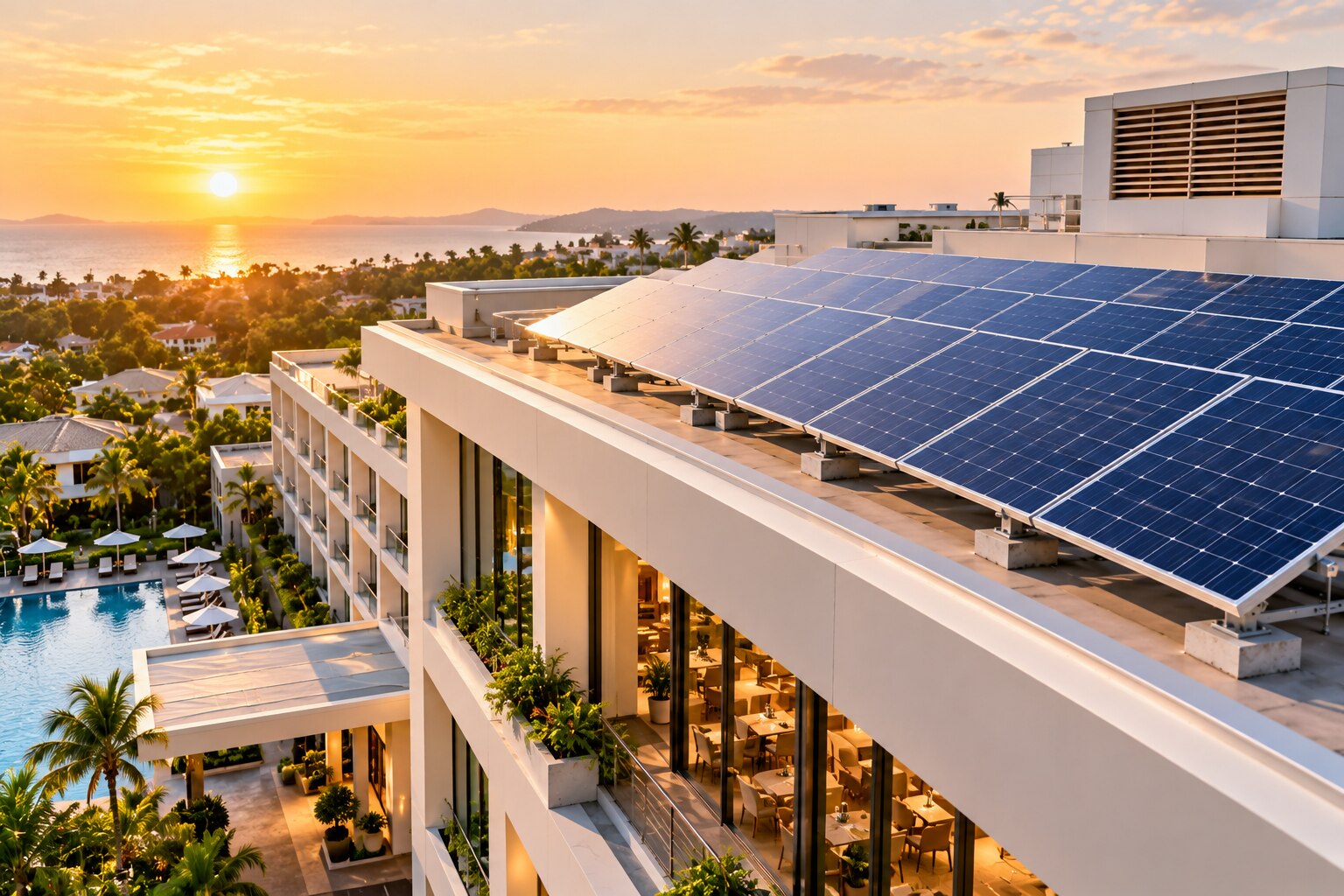
Hotels use electricity in different patterns: air-conditioning and chillers peak in hot afternoons, while guest rooms, refrigeration, ventilation and hot-water systems continue after sunset. A hotel owner can use bills, interval data, roof constraints and tariff rules to decide what solar can offset, whether efficiency upgrades come first, and whether batteries are worth their cost.
Key takeaways
- Map every major load by hour before calculating panel capacity.
- Reduce cooling, hot-water and lighting demand before sizing solar.
- Check usable roof area, shading, structural capacity and electrical limits.
- Match the system and tariff to the hotel’s daytime and evening loads.
Map the hotel’s loads before calculating panel capacity
Do not size the array from annual electricity use alone. A hotel energy audit must show when each load operates, because solar produces mainly during daylight while occupancy, ventilation, refrigeration and hot-water demand continue after sunset.
1. Build a hotel load map from the latest 15-minute or 30-minute interval meter data and at least 12 months of electricity bills. Record annual kWh use, sanctioned load, monthly maximum demand and tariff intervals, then compare weekday and weekend profiles.
2. Sub-meter or estimate the major electrical loads: guest-room air-conditioning, water heaters and heat pumps, kitchens, laundry, elevators, lighting, pumps, refrigeration, banquet halls and offices. Separate electric equipment from gas boilers, gas cooking and other fuel-fired appliances; photovoltaic electricity offsets the former, not the fuel consumed by the latter.
3. Label each load as base load, peak load or seasonal load. Base load includes continuously running pumps, refrigeration and essential ventilation. Peak load rises during check-in, meal periods, weddings and conferences, while summer cooling can create a separate seasonal peak.
4. Calculate daytime consumption from the interval profile, then model solar output against it. The self-consumed share is the solar generation that coincides with hotel demand; surplus is exported, and evening or overnight demand requires grid supply or storage.
5. Test occupancy, conference, weather and tariff scenarios before approving capacity. A panel count based on annual kWh can overstate savings if most demand occurs after sunset or if the array’s output exceeds the hotel’s daytime load.
Reduce demand first, then match solar to the operating schedule
Compare efficiency upgrades with photovoltaic panels on both energy saved and timing. A kilowatt-hour avoided by a measure is usually more valuable than a kilowatt-hour exported after the hotel’s daytime demand is covered.
| Measure | What it changes | Compare it with PV when |
|---|---|---|
| Inverter air-conditioners | Reduce cooling electricity and cycling losses | Rooms and common areas need cooling during daylight |
| Heat-pump water heaters | Use electricity to move heat instead of making it directly | Hot-water demand can be scheduled from late morning to afternoon |
| Solar water heating | Uses sunlight to heat water without PV electricity | The hotel has roof area, strong hot-water demand and backup heating |
| LED lighting | Cuts lighting load and lowers heat added to cooled spaces | Corridors, rooms, parking areas and public spaces operate for long hours |
Do not compare PV with fuel savings as if they were equivalent. PV offsets electricity used by electric heaters, pumps and heat pumps; it does not directly replace gas or other fuel burned in boilers, kitchens or gas-fired water heating.
A hotel’s daytime demand matches PV generation when its interval profile stays above the PV output during daylight. Cooling, kitchen service, laundry, elevators, refrigeration, pumps, offices and occupied banquet areas create this overlap. Generation is strongest from roughly 9 a.m.
to 4 p.m., but weather, shading and hot modules reduce actual output below the nameplate rating.
Evening occupancy, overnight ventilation and hot-water recovery can leave demand after sunset. Use interval data to test self-consumption, exports and demand-charge peaks; a battery or load controls is needed when the monthly peak occurs after PV production.
Size the rooftop system around usable roof area and electrical limits
Start with 15-minute or 30-minute interval data, not annual kWh alone. Compare daytime hotel demand with solar output, then check sanctioned load, transformer capacity, main-panel rating and the utility’s permitted export. A large annual bill does not justify an array the roof or electrical service cannot accept.
- Draw the roof to scale and calculate usable shadow-free roof area after removing HVAC units, water tanks, parapets, vents, walkways, fire access routes, drainage zones and maintenance clearances. Reserve space for future equipment and safe isolation.
- Apply the chosen panel wattage to the remaining layout, not to the roof’s gross area. For example, 500-watt modules need their full module footprint plus spacing; rows packed tightly on paper may create shading, unsafe access or wind-uplift problems.
- Evaluate roof orientation and tilt with shading software using nearby buildings, parapets and seasonal sun angles. A lower-yield layout that preserves fire lanes and service access is more practical than a larger, obstructed array.
- Select inverter capacity from the modeled DC array, interval load profile, voltage, phase arrangement and interconnection limit. Check clipping, reverse power protection, rapid shutdown requirements and whether the existing switchgear can accept the proposed connection.
Have a structural engineer verify dead load, wind uplift, roof condition and attachment points before approval. Model cloudy years, soiling and inverter downtime rather than multiplying capacity by full-sun hours. Finally, test whether generation coincides with the hotel’s demand peak; solar lowers kWh use, but a late-evening peak can leave demand charges unchanged.
Choose the system and tariff arrangement that fits hotel operations
Choose on-grid solar for a hotel with reliable grid supply and substantial daytime consumption. Choose hybrid solar when outage protection, demand-charge reduction or export limits justify batteries. Choose off-grid solar only when grid service is unavailable or prohibitively costly; the battery and generator capacity required for air-conditioning, kitchens and water heating can make it expensive.
| Option | Best fit | Main limitation |
|---|---|---|
| On-grid solar | Daytime loads and dependable grid supply | Shuts down during a grid outage; does not automatically remove demand charges |
| Hybrid solar | Critical loads, peak shaving and controlled backup | Battery usable capacity, round-trip losses, degradation and fire protection add cost |
| Off-grid solar | Remote hotels without dependable utility service | Requires oversized PV, batteries and often a generator for cloudy periods and night loads |
Compare the hotel’s maximum-demand intervals with solar output, not only monthly kilowatt-hours. PV lowers energy consumption, but a late-evening cooling or kitchen peak still attracts a demand charge; battery dispatch or load controls must coincide with the utility’s measurement interval.
In Maharashtra, model both tariff routes using the current MERC order and the hotel’s distribution utility interconnection terms:
- Net metering offsets imported units with eligible exported units under the approved arrangement; confirm capacity limits, export caps and standby charges.
- Gross metering sends generation to the grid for the approved export rate while the hotel buys its consumption separately; do not value exports at the retail tariff.
- Ask the utility to confirm application category, meter configuration, sanctioned-load conditions and settlement period in writing.
Use interval data and cloudy-year scenarios before adding storage. A battery sized only from PV capacity can disappoint when export compensation is higher than battery value.
Make the project financially and operationally dependable
Approve the project only after the roof, revenue assumptions, approvals and operating responsibilities survive a written review.
1. Confirm the roof’s remaining service life, structural capacity and warranty conditions. If replacement is planned, price removal and reinstallation of panels, racking and cables, and coordinate every penetration with the roofing contractor.
2. Rebuild the financial model using the hotel’s MSEDCL tariff category, sanctioned load and maximum-demand history. Separate savings from self-consumption and export; do not value exported units at the retail rate. Use the actual MSEDCL interconnection agreement, export limit, net-metering eligibility, charges and standby provisions under MERC regulations.
3. Obtain a written approvals schedule covering the DISCOM application, interconnection study, electrical safety inspection, meter changes, fire-access requirements and any building or local-authority permissions. Assign an owner and deadline for each approval.
4. Require monthly or interval-based production scenarios, not one annual yield figure. Test high temperatures, soiling, shading, inverter clipping, curtailment and a cloudy year against occupancy, cooling and banquet loads. Check whether solar output overlaps the interval used for demand charges; batteries or controls may be needed for night-time peaks.
5. Put solar monitoring and maintenance into the contract. Specify alarm response times, inverter and electrical inspections, cleaning, corrosion checks, storm-damage response, vegetation and debris removal, safe roof access and replacement responsibility.
6. Ask SunsetLife Solar Pvt. Ltd to provide a roof plan, structural review, single-line diagram, equipment warranties and a performance shortfall process before signing. Payment milestones should follow documented installation, commissioning and approval evidence.
Related products
 | Commercial Solar Rooftop System Commercial Solar Rooftop System The Commercial Solar Rooftop System is a cost-effective solution for offices, shops, malls, hospitals, schools, and commercial buildings. View product → |
 | Solar Panel Installation Solar Panel Installation Services We provide end-to-end Solar Panel Installation Services, including site survey, system design, installation, testing, and commissioning. View product → |
Frequently asked questions
Why should a hotel map its loads before sizing solar panels?
Solar generation is concentrated in daylight, while hotel loads such as occupancy, ventilation, refrigeration and hot-water systems continue after sunset. An hourly load map shows how much solar power the hotel can use directly and how much it may export or store.
Should a hotel reduce energy demand before installing solar panels?
Yes. Improve cooling controls, lighting, hot-water systems and other major loads first, then size solar against the reduced operating demand and schedule.
What limits the size of a hotel rooftop solar system?
Usable roof area, shading, structural capacity, access space, inverter capacity, transformer limits, sanctioned electrical load and the building’s interconnection point all affect system size.
How should a hotel choose between solar system and tariff arrangements?
Compare the hotel’s daytime demand, evening demand, export rules, demand charges, battery requirements and available tariff or metering arrangements before selecting the system structure.
Related product
 | On-Grid Solar Power System On-Grid Solar Power Systems are connected to the electricity grid, allowing users to export excess power and benefit from net metering. View product → |