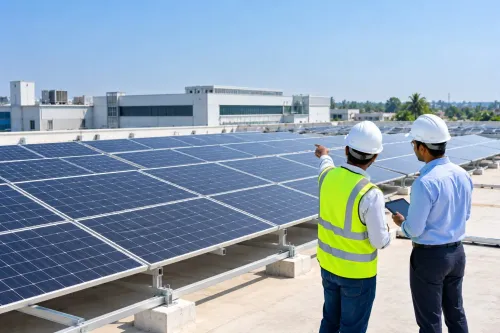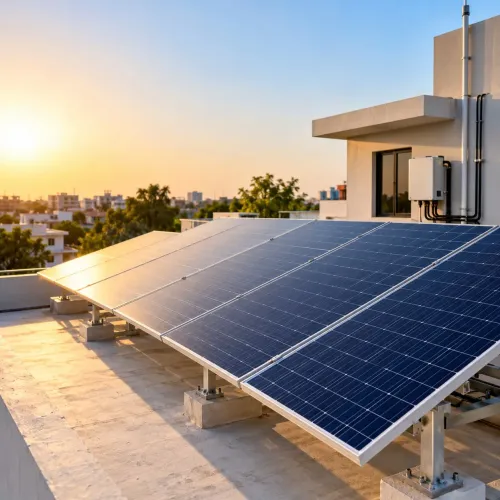
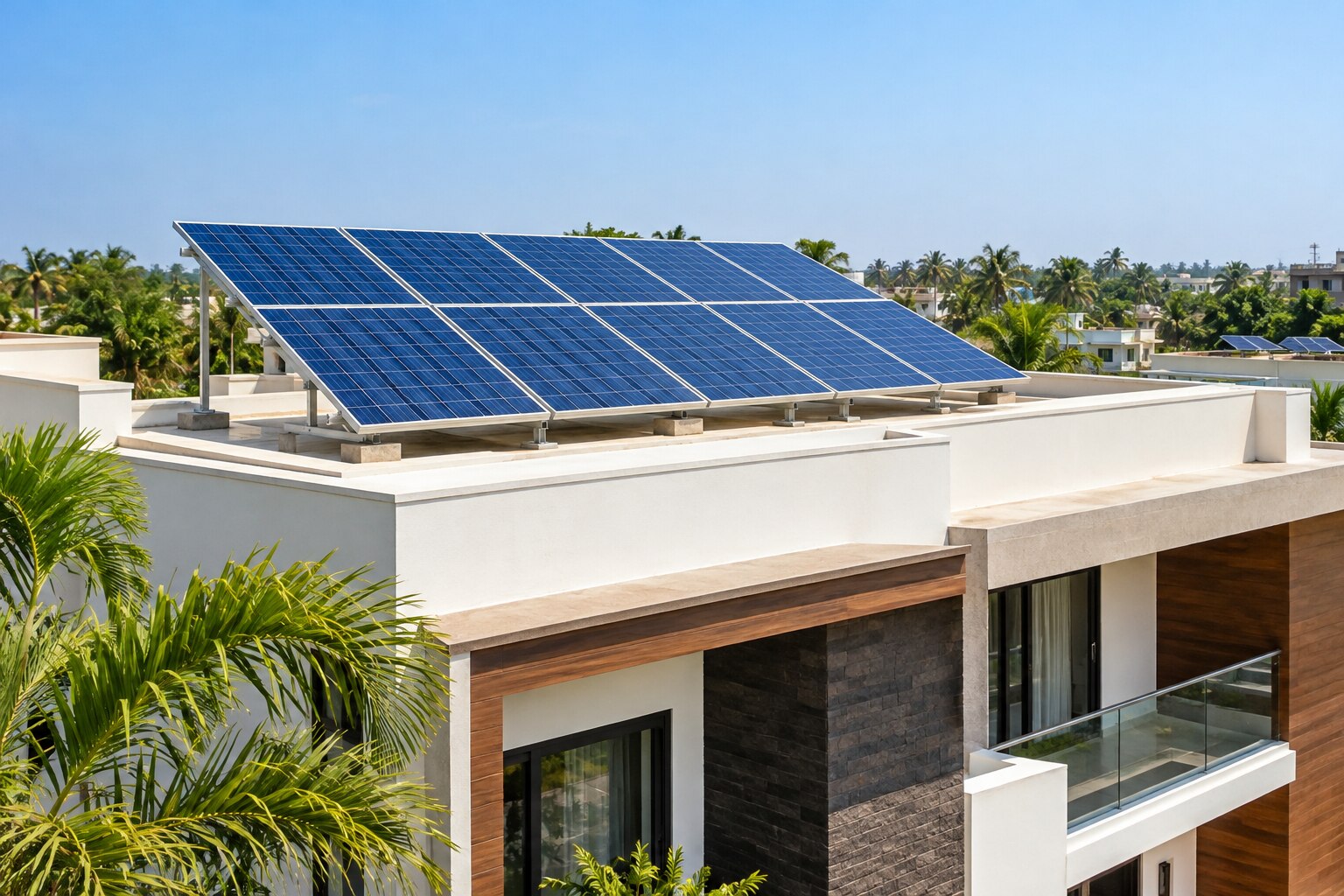
Start with at least 12 months of electricity bills, then test the required system size against usable roof area, shading, household load timing and equipment limits. By the end, you will be able to compare panel datasheets, estimate a site-specific array size and identify the design checks that matter before requesting a quotation.
Key takeaways
- Use 12 months of bills and include planned loads before sizing.
- Measure obstruction-free roof area before selecting panel wattage.
- Compare temperature coefficient, degradation rate, warranty, and low-light performance.
- Design panel strings around inverter limits and the roof’s shading pattern.
Turn Your Electricity Bills Into a Solar System Size
Use 12 months of electricity bills, not the largest bill, to establish your monthly kWh and annual electricity consumption. Add planned demand from air-conditioning, an electric vehicle, heat pump or pool pump before sizing the array.
Use this first-pass equation:
Required DC array size (kW) = target annual PV energy (kWh) ÷ site-specific yield (kWh/kW-year)
Your site-specific yield must account for location, roof tilt and direction, shade, weather, wiring losses, inverter efficiency and temperature. A universal claim that 1 kW produces the same energy everywhere is unreliable.
- Add each bill’s kWh to calculate annual electricity consumption.
- Mark daytime and evening loads separately; panels do not directly cover night use without a battery.
- Check seasonal variation, especially high summer air-conditioning demand.
- Include future loads before requesting quotations.
- Compare self-consumed, exported and battery-charged energy under your tariff.
| Monthly use | Annual target | Array sizing expression |
|---|---|---|
| 300 units per month solar sizing | 3,600 kWh | 3,600 ÷ site-specific yield |
| 600 units per month solar sizing | 7,200 kWh | 7,200 ÷ site-specific yield |
| 1,000 units per month solar sizing | 12,000 kWh | 12,000 ÷ site-specific yield |
These figures show the method, not a guaranteed panel capacity. Your target annual PV energy may be lower than annual consumption if export payments are poor, or higher if future loads are imminent. A grid-tied system also will not power evening appliances or a blackout unless its inverter and battery provide backup.
Calculate Usable Roof Area Before Choosing Panel Wattage
A 10 m × 6 m roof does not provide 60 m² of usable rooftop capacity. Start with the roof dimensions, then subtract roof setbacks, parapet shadows, water tanks, solar water heaters, skylights, access paths and maintenance clearances.
A 2 m² panel footprint means twenty 450 W panels need about 40 m² before these exclusions; higher wattage reduces panel count, not required area.
Map roof orientation, tilt and shade hour by hour. A south-facing roof may maximise annual production, while a west-facing roof can better match late-afternoon demand. Trees and neighbouring buildings create partial shade; parapet shadows and multiple roof levels can split panels into different operating conditions.
| Feature | Effect on panel layout | Check before choosing wattage |
|---|---|---|
| Roof orientation and tilt | Changes annual output and production timing | Model each roof plane, not the whole villa as one surface |
| Shade sources | Reduce output during specific hours and can constrain a string | Record shadows from trees, parapets and neighbouring buildings |
| Roof material | Determines fixing method and waterproofing risk | Identify tile, concrete slab, metal sheet or another surface |
| Structure and age | Limits mounting weight and resistance to wind uplift | Inspect roof age, framing condition and the mounting weight |
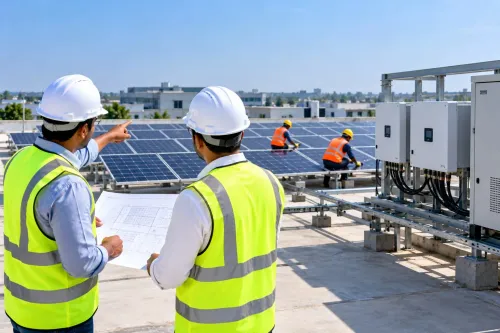
Measure each roof plane separately and mark exclusions on a scaled drawing. Reject a layout if panels block drainage or service routes. Replace an old roof before installation when its remaining life is shorter than the solar array’s planned service period.
Compare Panel Technologies and Datasheets on the Figures That Matter
Start with usable output per square metre, not module wattage alone. A panel’s STC nameplate uses 1,000 W/m², 25°C cell temperature and the AM1.5 reference spectrum; rooftop cells run hotter, so real output is lower. Compare panel efficiency with module size and module weight when roof area or structure is tight.
| Technology | Space and heat implication | Datasheet checks |
|---|---|---|
| Monocrystalline panels | Usually the strongest choice for limited roof area | Efficiency, temperature coefficient, degradation rate |
| Polycrystalline panels | Often needs more area for the same capacity | Efficiency, module size and price |
| Thin-film panels | Can perform well in heat but often occupies more roof area | Efficiency, operating-temperature range and mounting method |
For a hot villa, compare the negative temperature coefficient rather than choosing the highest STC rating. A less powerful module with a better coefficient can produce more during hot afternoons. Check the cold-weather open-circuit voltage against the inverter’s maximum voltage, even in warm climates.
Treat bifacial performance as site-specific: it adds value only when the rear receives reflected light, not when the module sits close to an opaque roof. Also check the mechanical load rating for wind and snow exposure, plus module weight and racking loads.
For long-life selection, read both the product warranty and performance warranty. Compare the warranted end-of-life output and degradation rate, not only first-year wattage; a common planning assumption is about 0.5% annual degradation, but the warranty terms control the promise.
Match the Panels to the Inverter and Shading Pattern
A safe match is confirmed by checking worst-case voltage, current and shade behaviour—not by comparing panel kilowatts with inverter kilowatts.
- Record each module’s maximum-power voltage, maximum-power current, open-circuit voltage and short-circuit current.
- Calculate string voltage at the coldest expected temperature. Cold-weather voltage must stay below the inverter’s maximum DC input voltage and the system’s maximum voltage rating.
- Check the string’s operating voltage and current against the inverter’s MPPT operating range and current limits. A high-wattage array can still fail if its voltage or current exceeds those boundaries.
- Confirm the inverter’s AC output fits the villa’s AC service capacity, including the main breaker and other large loads.
Treat each roof plane as its own electrical problem. Multiple roof orientations or different shade patterns need separate MPPT inputs; placing them in one string forces the better-performing modules to follow the weaker ones. Partial shading from a chimney, parapet or tree can reduce string output for limited hours.
Bypass diodes reduce hot-spot risk, but they do not restore normal production from a shaded module.
Use optimisers or microinverters when the layout makes module-level control worthwhile. Compare their voltage, current and shutdown ratings with the module datasheet.
A DC-to-AC ratio above 1 can add morning, afternoon and winter production, while causing midday clipping. Model the energy trade-off rather than accepting a fixed ratio.
Finally, a grid-tied outage shuts down the inverter through anti-islanding protection. Battery backup requires a separately designed battery inverter, protected backup circuits and load capacity.
Choose the Design That Delivers Value, Not Just Maximum Panel Capacity
Choose the proposal with the best value per rupee, not the largest DC capacity. Compare each design using your tariff, load timing, roof constraints and service obligations.
| Option | Compare on | Value question |
|---|---|---|
| PV sized for daytime loads | self-consumed solar energy and exported energy | Does utility export compensation justify the surplus after fixed charges? |
| PV plus battery | battery-charged energy, battery usable energy and battery cycling | Does shifting evening loads beat round-trip losses and replacement cost? |
| Maximum-capacity array | annual kWh, system-size caps and export limits | Will extra panels earn less than their installation and maintenance cost? |
Ask for a site-specific production model, not a universal kWh claim. It must show monthly generation, self-consumption, exported energy, annual degradation and warranted end-of-life output. Include fixed charges and demand charges where they apply; a smaller array can deliver better economics when export compensation is low.
Size storage from the loads you want covered and the required hours. Battery usable energy is approximately required load energy divided by usable depth of discharge and round-trip losses. Check continuous power for pumps and normal appliances, then surge power for compressor starts and simultaneous cooking loads.
Before comparing prices, require these proposal details:
- A site survey recording waterproofing, corrosion environment, roof age and maintenance access.
- A panel layout, racking load, inverter model and service response terms.
- Warranty conditions covering workmanship, battery cycling limits and replacement responsibilities.
Whether you choose SunsetLife Solar Pvt. Ltd or another installer, insist that these figures appear in writing.
Related products
 | Residential Solar Rooftop System Residential Solar Rooftop System Residential Solar Rooftop Systems are designed to convert sunlight into clean, reliable electricity for homes, helping homeowners reduce energy costs... View product → |
 | Commercial Solar Rooftop System Commercial Solar Rooftop System The Commercial Solar Rooftop System is a cost-effective solution for offices, shops, malls, hospitals, schools, and commercial buildings. View product → |
Frequently asked questions
How do I calculate the solar system size for my villa?
Use 12 months of electricity bills to find annual and monthly kWh, then add planned demand from air-conditioning, an electric vehicle, a heat pump, or a pool pump.
How much roof area do solar panels need?
Measure the obstruction-free area after allowing for parapets, tanks, ducts, walkways, setbacks, and maintenance access. Divide usable area by each panel’s footprint to compare layouts.
Which solar panel specifications matter most for a villa rooftop?
Compare rated power, physical dimensions, efficiency, temperature coefficient, annual degradation, product and performance warranties, operating temperature range, and low-light behaviour.
How should solar panels be matched with an inverter?
Check the inverter’s maximum DC voltage, MPPT voltage range, maximum input current, and total DC capacity. Arrange strings according to roof orientation and shading rather than panel count alone.
Related products
 | Solar Panel Installation Solar Panel Installation Services We provide end-to-end Solar Panel Installation Services, including site survey, system design, installation, testing, and commissioning. View product → |
 | On-Grid Solar Power System On-Grid Solar Power Systems are connected to the electricity grid, allowing users to export excess power and benefit from net metering. View product → |
 | Hybrid Solar Power System Hybrid Solar Power Systems combine the benefits of on-grid and off-grid solutions. View product → |
 | Industrial Solar System Our Industrial Solar Power Plants are designed for factories, warehouses, and large-scale manufacturing units. View product → |